PRODUCT
The deal briefing: why we built the closing playbook into the product.
Written by
Mohamed Wajahat
Content
What every AI chat tool gets wrong about sales.
Most AI chat tools think the product is the conversation. Visitor asks question, bot answers, conversation ends. Lead gets captured. Founder reads the chat transcript later. Deal gets worked.
That model is broken in two specific ways, and the second one is what we built ClientX around.
First: the chat is rarely the qualifying signal. A visitor asking "do you integrate with Salesforce?" tells you very little about whether they're a buyer. The qualifying signals are behavioral. How many times have they been on the site? Which pages? How long? What's their company?
Second: even if you have a qualified lead, the conversation transcript is the wrong format for closing them. A founder doesn't want to read a 40-message back-and-forth to figure out what to say. They want to know what to do next. In four lines.
What the deal briefing actually contains.
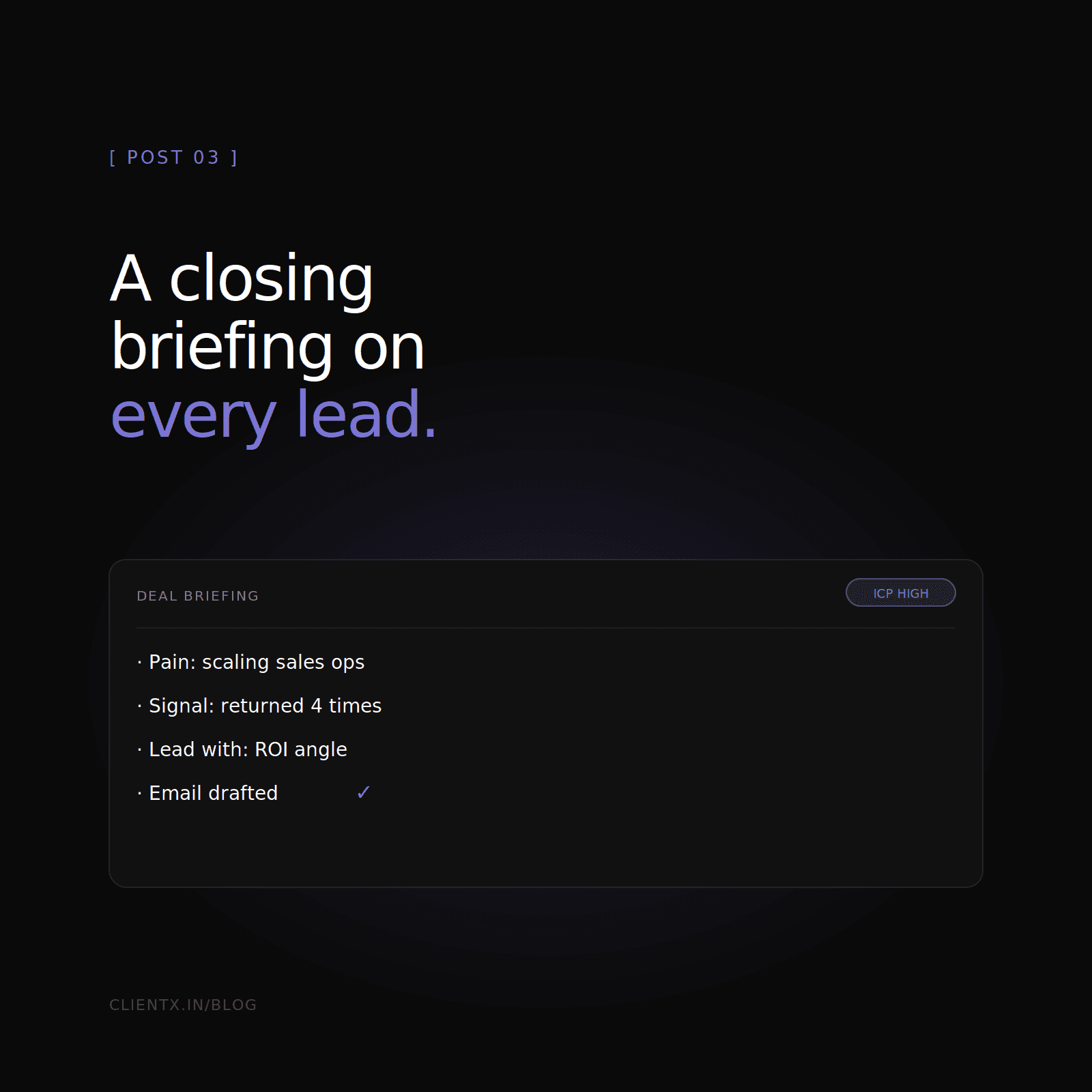
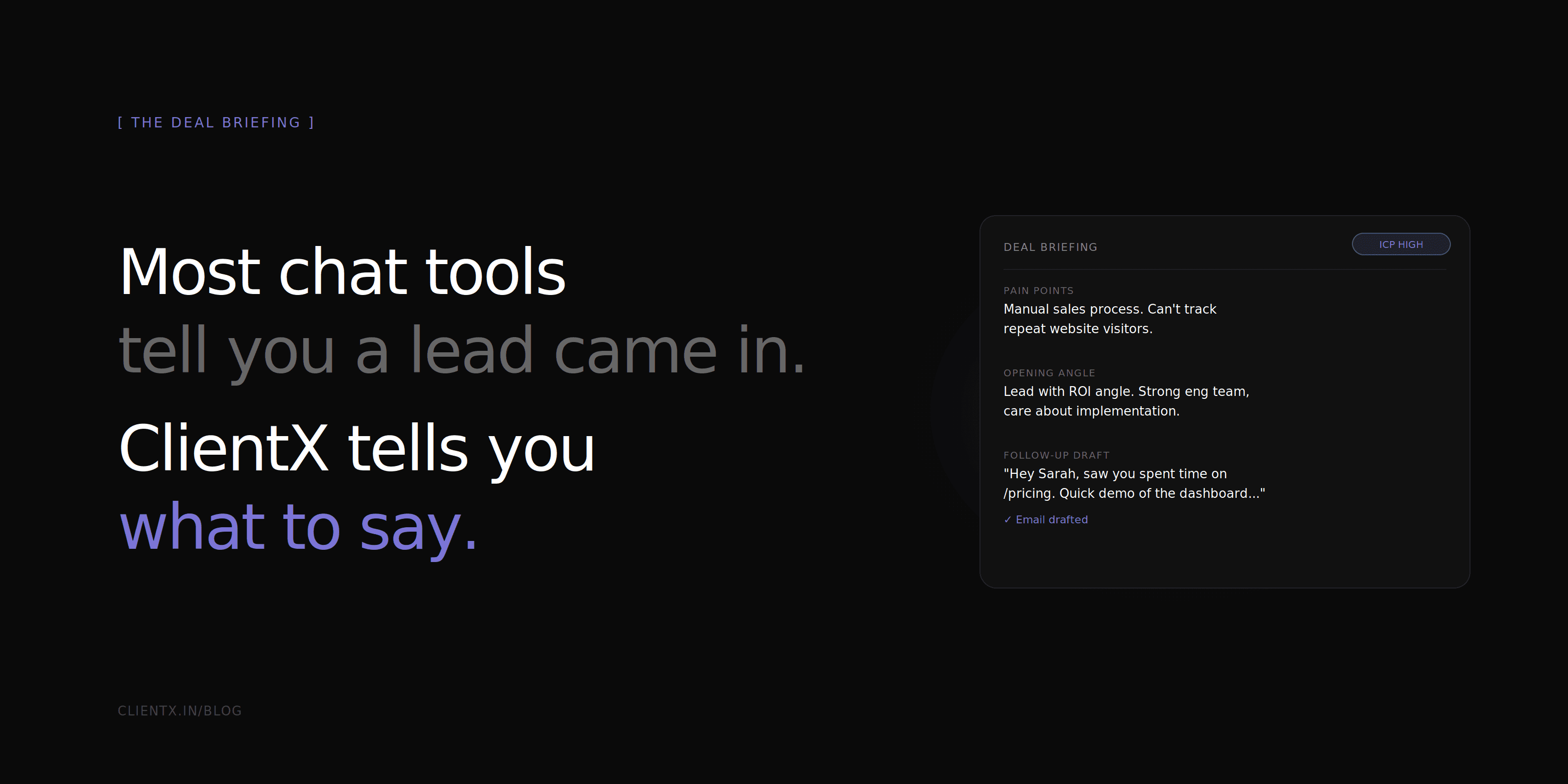
When a visitor crosses the qualified threshold during a ClientX conversation, the system fires a Sonnet call that produces a structured briefing with five fields:
Pain points: What did they tell us hurts? Extracted from their messages, often phrased differently than the chat transcript.
Buying signals: Behavioral evidence of intent. Returned 4 times. Spent 9 minutes on pricing. Watched the demo video twice.
Likely competitor evaluation: Inferred from their questions, the pages they visited, and their company profile.
Opening angle: The single most important field. What should the founder lead with on the call?
Follow-up email draft: A ready-to-send email referencing specific things from the conversation, with a clear next step.
The whole thing fits on a phone screen. It's the briefing an SDR would write, except produced in 4 seconds, while the visitor is still on the site.
It's the briefing an SDR would write, produced in 4 seconds, while the visitor is still on the site.
Why this is hard to build.
Generating a useful deal briefing from a conversation is not the same as summarizing it. Summarization would give you "the visitor asked about pricing and integrations, then gave their email." Useless.
The briefing has to do four things at once:
Extract subtext. The visitor asked about pricing for 50+ users. That's not a question. That's a pain point about scale, with an implicit budget signal.
Cross-reference behavior. They asked about HubSpot integration but they're already on a HubSpot domain. They're consolidating, not exploring.
Infer the competitive set. Their question phrasing suggests they've used Drift before.
Recommend a next move that ties all of the above into one specific action.
This is reasoning, not summarization. Sonnet 4.5 was the first model that produced briefings consistent enough to ship.
What changes when you have it.
Founders we've shown this to consistently react the same way: they open the dashboard, see a briefing, and immediately understand the value before anyone explains it.
The change in their behavior is observable:
They check ClientX faster after a notification
They send the follow-up email within the hour because it's already drafted
They walk into the demo call with a thesis instead of discovering one mid-conversation
One customer told us: "It's the difference between getting a lead and getting a lead with notes from your best SDR."
Why we built this and not what others built.
Drift, Intercom, Chatbase, Tidio, they all built better chat. More accurate AI, better routing, more integrations. The chat got incrementally better every quarter.
The actual job to be done is closing more deals from website traffic. Better chat is upstream of that. But it's not the same thing.
Closing more deals requires the human to have the right context at the right time. The chat captures the context. The briefing delivers it to the human. Without the briefing, the chat is data the founder has to mine. With the briefing, the chat is fuel the founder uses.
The honest limitation.
Deal briefings are good when the conversation has substance. Visitor said three sentences and gave an email? The briefing will be thin. Visitor had a 12-message qualifying conversation? The briefing will be excellent.
This isn't a bug. The product is matching its output to its input. We don't fabricate detail. If the conversation didn't surface a competitor evaluation, the briefing doesn't guess one.
The result.
Most chat tools tell you a lead came in. ClientX tells you what to say.
That's the entire pitch. Everything else, the live view, the AI agent, the integrations, exists to make the briefing better.