INSIGHTS
Why your visitors come back four times before saying hello.
Written by
Mohamed Wajahat
Content
The data point that changed how we think about B2B websites.
We tracked every visitor on a B2B SaaS client's site for 60 days. The site was running roughly $4,000/month in LinkedIn ads driving qualified traffic.
Here's what the data showed:
Average qualified visitor came back to the site 3.7 times before any form submission
30% returned 5+ times
Median time between first visit and lead capture: 9 days
Only 8% of qualified leads converted on their first visit
The form submission is not the start of their journey. It's the end.
The implication is uncomfortable. Most of your B2B buyers are silently watching you for over a week before they ever say hello. And every standard analytics setup is blind to this entire process.
What B2B buyers actually do.
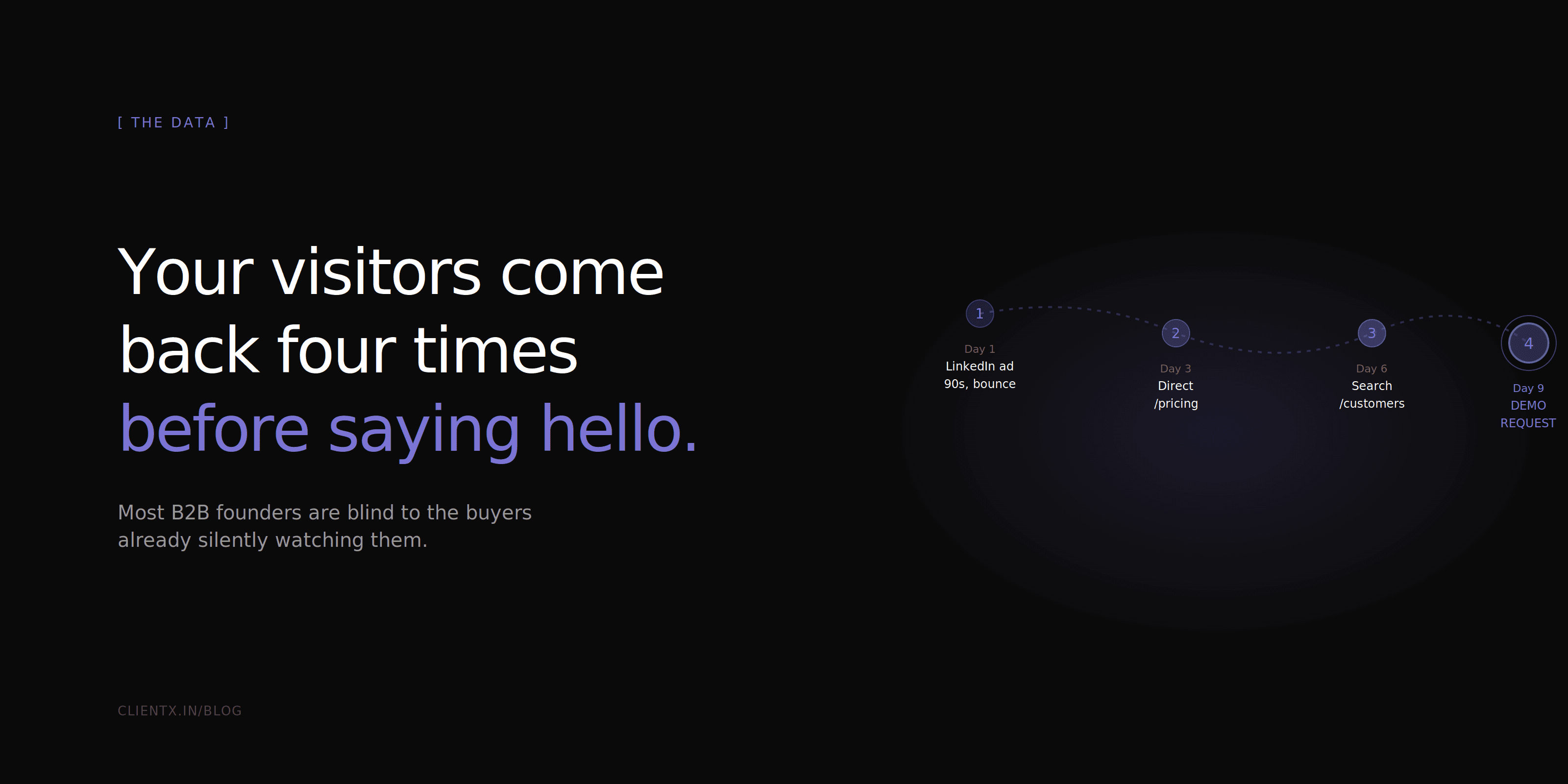
The pattern, when we mapped it across visitor sessions, looked like this:
Visit 1: Arrived from a LinkedIn ad. Spent 90 seconds on the homepage. Left.
Visit 2: Two days later, direct traffic. Hit the pricing page. Spent 4 minutes. Left.
Visit 3: Three days after that, Google search for the company name. Visited the customers page and the pricing page. Spent 7 minutes. Left.
Visit 4: The next day, direct traffic. Pricing page, FAQ, blog post about implementation. 11 minutes. Submitted a demo request form.
By the time they fill out the form, they've already evaluated the product. They've compared pricing. They've read your customer stories.
The form submission is not the start of their journey. It's the end.
Why this is invisible to most founders.
Standard analytics tools count sessions, not journeys. Google Analytics will tell you that you had 240 sessions last week. It won't tell you those 240 sessions came from 60 unique humans, each visiting 3 to 5 times.
The result: founders chronically under-estimate their funnel. They see "240 sessions, 12 leads, 5% conversion" and think they need more traffic. The real picture is "60 unique buyers, of whom 12 converted after multiple visits, and 48 are still in the buying process."
What this means for your sales motion.
Three implications, in increasing order of impact:
One: Stop optimizing for first-visit conversion. Nobody converts on their first visit.
Two: Stop measuring funnel stages independently. The visitor who looked at pricing and bounced isn't lost. They're in stage two.
Three: Start tracking returning visitors as your most valuable signal. A visitor who returns 4 times is probably going to become a lead.
What we did about it.
This data is exactly why we built ClientX the way we did. The live view exists to surface returning visitors before they convert. Intent scoring exists to flag the visitor who's been on pricing three times this week.
The shift in mental model is the biggest unlock. Once a founder sees a returning visitor in real time, they don't need any further convincing about why visibility matters.
The conversion rate on warm outreaches is 3 to 5x higher than cold form follow-ups. Not because the message is better. Because the timing is right.
The four-visit threshold.
If we had to pick one number to anchor on: four visits.
Visitors who return four or more times are 7x more likely to convert than first-time visitors. They're also 60% more likely to convert at a higher ACV than form-submitted leads.
Catching them at visit four is the highest-leverage moment in the entire B2B sales funnel.
What to do tomorrow.
If you don't have visitor identification yet, start there. Even basic IP-to-company resolution will surface 30 to 50% of B2B traffic.
If you do have it, build a list of "returning visitors who haven't converted." Sort by visit count. The top of that list is your warmest pipeline you've never talked to.
Find them.